25 November, 2015

When the Church Gets It Wrong

After posting a blog on Friday, (But What If the Church is Wrong?) I was running errands and mulling over (read obsessing over) whether I should have posted it.  I kept hearing my head the words from Bishop C. Andrew Doyle's new book, "nothing is more threatening to the life and mission of the Church than cynical and negative leadership." (p. 3) I wondered, "Is that how people will read it?" I don't think I'm a cynical and negative leader, but what if that's how people read it? I don't want to come across that way; I'm not that way, but what if people misunderstand?

I was worried about colleagues and friends in the church who might misunderstand what I was trying to say.  I was worried because I have been told before I don't accept my priestly authority. I was worried I would be seen as a troublemaker, a pot stirrer, an unhappy priest--none of which I consider myself because I'm not.  And let me be really honest, I'm in search (Episcopal code for looking for a job), and I certainly don't want any parish to think I'm not hopeful for the future, that I don't believe there is a place, a much needed place, for the mission and ministry of the Church in the world because I most certainly do, and I desperately want to be a part of it. But I also think we have to look very hard at who we are and how we are in the world.

Hear me (ok, read me), it wasn't that I didn't believe what I wrote.  It wasn't that I didn't and don't struggle constantly with the questions I posed, it was something else--I was struggling with how it would be received.  Was I too harsh? Too judgmental myself? Too holier than thou?  So as I was turning into my neighborhood I decided I would take it down.

I didn't--I didn't because when I opened my computer there were messages from colleagues and friends saying thank you.  Thank you for writing this. So I didn't take it down, but I continued struggling with the question--what if the church is wrong? If I'm really honest, the questions that reverberate from the post is why do I stay?  Why do any of us stay? And why do I so desperately want to be a part of it?

Very good questions....

Tomorrow seated at our table will be all four of our children--all reared in the Episcopal Church. One continues to be very involved in the church--it has been said by more than one person on more than one occasion they believe she will one day be ordained.  A second wants nothing to do with church and in fact often says he doesn't believe at all.  The other two are somewhere in between. And yes, I do believe their feelings and beliefs do come from what they've experienced in the church.  I do believe the church they've witnessed bears some responsibility. We sometimes have heated debates; we sometimes have to drop the subject; we sometimes raise our voices. And yes, it's hard.  So the question remains--why?

I believe the answer comes not from focusing on the question what if the church is wrong, but rather what does the church do when it is wrong?

Presiding Bishop Michael Curry initiated a good bit of my former question with his All Saints Sermon.  Presiding Bishop Michael Curry who is African American--our first African American Presiding Bishop--the Presiding Bishop of the Episcopal Church, the church who for centuries supported slavery. On October 4, 2008, the Episcopal Church apologized for it's role (Episcopal Church Apologizes) and now we have an African American Presiding Bishop who leads us, challenges us, inspires us.

That's why I stay--because we have been and can be a place that takes responsibility, because when we are wrong we bear witness to a community that can extend love and mercy and forgiveness and grace.  When we are wrong and we admit we are wrong, we can model for the world what it means to take responsibility, to own our past, to learn from our mistakes and to move forward with love.

Bishop Doyle also asks in his book, "To adapt to the VUCA world, what must the Church give up? What must the Church take on?" (p. 18) (VUCA world = volatility, uncertainty, complexity, ambiguity). I believe the Church needs to give up it's absolute certainty in all matters and take on being a place to question, a place to bring our doubts, our fears, our anger and our joys, and our grief and our solace.  I believe it needs to continue to be a place where we can  practice grace, mercy, forgiveness and WHEN we get it wrong it is a place where we can start again.

I am not negative and cynical.  I claim my priestly authority. And I believe in the God "who is and who was and who is to come" (Revelation 1:4 NRSV) I believe the Church can and is an institution with faults but I believe it can and is an institution that at its best serves Jesus' cause--I also believe we have to be honest about who we are as individuals and as the church.

Here's how I honestly understand who I am...

I am not a negative and cynical leader in the church; I do accept and claim my priestly authority. I also claim I am a leader. (My therapist right now is high fiving herself for my ability to publicly say that...) I'll say it again; I am a leader, I am a leader, accepting my priestly authority and exercising it in my own way--in the way God created me to be.  I am a leader who leads expressing my uncertainty, admitting my vulnerability. For better or worse I am a clergy who lives out my vocation in a way Rachel Held Evans wonders about when she writes, "I often wonder if the role of the clergy in this age is not to dispense information or guard the prestige of their authority, but rather to go first, to volunteer the truth about their sins, their dreams, their failures, and their fears in order to free others to do the same." (p.112) 

I guess that blog on Friday was me going first--me going first admitting I question, I struggle, I hurt because of the hurt I know the church has caused.  But I also stay--

As I think about our children and where they are in their lives of faith, I could be angry at the role the church has played. But I'm not. I do wish it were different. But they're on their own journeys and I am honored to journey with them OR to let them journey alone. And I believe that just like we O'Doyles continue to love one another, accept one another, extend grace and mercy to one another--to gather around one table with our differences so can the church.

Tomorrow gathered in our home will be our family plus other families--families we have met and fallen in love with through the Church.  Families who have become our family. We will gather with our different nationalities, our different political views, our different theologies, our different beliefs--we might even talk about some of them.  But we'll also gather as people who love and accept--as people who try to practice mercy and forgiveness and grace.  As people who learned how to do that in the Church.

I stay because of what happens when the Church gets it wrong. I stay because we do get it wrong and by staying we get to start again and again and again--for as long as it takes.


Doyle, C.. Andrew; A Generous Community; Being the Church in a New Missionary Age. New York: Morehouse Publishing,        2015.

Evans, Rachel Held; Searching for Sunday. Nashville, Tenn: Nelson Books, 2015.


20 November, 2015

But What if the Church is Wrong?

Ugh!  Okay, here's the problem.  I've been delaying (read hiding,
avoiding running in the opposite direction as quickly as I can--I even considered running this morning in 28 degree weather to avoid this--now that's serious avoidance!) I've been avoiding writing this blog.  I don't want to write this; I don't want to; I don't want to; I don't want to! (Insert toddler tantrum complete with foot stomping) But last night as I lay in bed trying to sleep, I knew that I had to do it.  I didn't want to, but I had to. The weeks of avoiding had to come to an end, but gosh darn I don't want to....

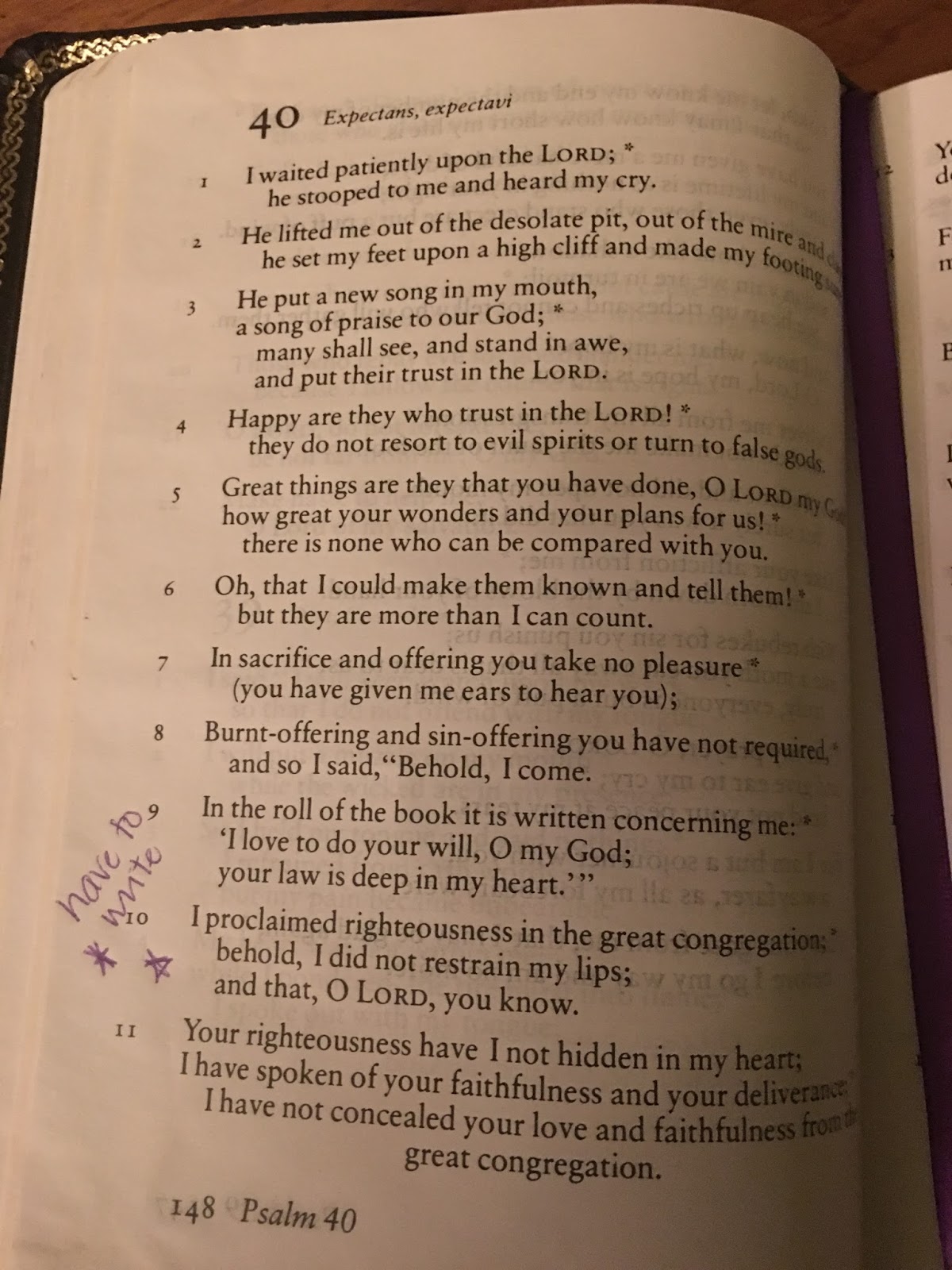
Last month as I was reading Morning Prayer (I'll be honest that day it was in the afternoon...) I read Psalm 40.  I planned to read quickly and move on--so much for planning.  I got to verse 10 and froze--seriously my brain, my body everything came to a screeching halt.  It read, "I proclaimed righteousness in the great congregations, behold, I did not restrain my lips; and that, O Lord, you know."  And my mind started screaming, but what if it's not righteousness we're proclaiming in our congregations?  What if it's self-righteousness?

See why I don't want to write this?  I am a priest in the Episcopal Church; I don't want to believe that I or anyone intentionally or unintentionally uses the pulpit for their own agenda. "Stop," I told myself knowing these thoughts were certainly not going to make me popular among some of my colleagues, "Stop. You're reading this out of context.  That's not the gist of this psalm. It's not what it's saying and you're doing what you're thinking some others do--using scripture inappropriately, out of context or for your own agenda. And I was right--in it's totality that's not what the psalmist was saying, and yet I couldn't move on. So I did what all slightly neurotic people do.  I began to research the actual meaning of "righteousness" (okay, I'll admit it; I became obsessed.  I tried to figure out a way to not hear what I was hearing.  I googled; I read every translation of the Bible I could get my hands on (and as a priest I have many). What I discovered can be summarized in this one sentence by N. T. Wright, "It thus donates not so much the abstract idea of justice or virtue, as right standing and consequent right behaviour within a community."N.T. Wright

It didn't help--in fact, it made it worse. Now I have to think about who gets to decide what's right behavior?  If it's the Church and more specifically those of us ordained to preach the Gospel, what if we're wrong?  There I've said it.  WHAT. IF. WE'RE. WRONG? And further what if we are so darn self righteous (defined as having or characterized by a certainty, especially an unfounded one, that one is totally correct or morally superior.) that we can't see it?

Over the past few weeks there have been many "signs" I have ignored speaking just to this topic or perhaps speaking to me--prodding me to actually reflect on this which means writing on this--reflecting and writing on the possibility, and sometimes the probability, that we can be wrong, misinformed, self-righteous or whatever word we want to use.  


One "sign" came to me in the Presiding Bishop's sermon on All Saints Sunday.  He said, "The truly liberating truth is that Jesus didn't come into this world to found a religion, though religious faith is important. Nor did he establish a religious intuition or organization, though institutions and organizations can serve his cause. You will not find an organizational table in the New Testament. Jesus came to continue a movement.  Actually, Jesus picked up and took the movement of John the Baptist to a new level. John was part of the movement born out of prophets like Amos and Isaiah and Jeremiah. And prophetic movement was rooted in Moses, who went up to the mountaintop. Jesus crystallized and catalyzed the movement that was serving God's mission in this world.  God has a passionate dream for this world. Jesus came to show us the way.  Out of the darkness into the dream."(Presiding Bishop Michael Curry's Sermon)

I keep returning to those words "institutions and organizations can serve his cause," and I also hear, "or can serve their own". I want to belong to an institution, to be part of an institution that serves his cause. I think in order to do that, I have to look critically, along with others, at that very institution.

I'm going to be honest--even as a priest in The Episcopal Church--I wanted to suppress the message from our Presiding Bishop--or at least the message I was hearing. (And believe me I have a very high regard for the authority of Bishops and I personally love this man.) But two things have forced my hand.  The first was yesterday reading Bishop Andy Doyle's (no relation to me, gosh darn it I wish he was) new book A Generous Community: Being the Church in a New Missionary Age. He writes, "As we ponder what the disciples are doing, it becomes clear that they are invested in a closed system. They want to control how Jesus is used, how Jesus relates, with whom Jesus spends time, and who has access to Jesus. Who they think should have access to God is impacted by their desire for control." (p.5-6) Bishop Doyle is talking about Jesus' disciples, but I suspect he could be talking about us--the Church, the ordained and lay leaders of the Church--today.


The second is the faces---the week after reading Psalm 40 and hearing Presiding Bishop Curry's sermon, Louisville Collegiate Schools presented The Laramie Project. It was the story of Laramie Wyoming the year following the murder of Matthew Shepherd. (The Laramie Project) It was powerful, emotional, and incredibly well done.  After every show there was an opportunity for a talk back session with the cast and audience.  Each night a different "professional" was asked to lead the talk back.  I had the distinct honor to be asked to lead the talk back about religious institutions response.

I sat on the stage with these young people as they processed--as they talked about the religious institutions responses then to this event and now to others.  I was so impressed by their courage, their candor, their passion, and I have been haunted by their exhausted, pained, courageous faces and their words.  Here's what I heard...

A senior who is articulate and mature said in a very respectful and serious tone, "I'm an atheist so I have to admit I don't totally get your perspective.  But what I really don't understand is how Christians can just blindly believe what a person in a pulpit tells them is right or wrong regardless of, well regardless of just about anything. How can you not question?"

Tears streamed down one young woman's face as she said, "What continues to haunt me--what I can't get over--what I hate hearing every night-- is the words of the Baptist preacher. 'I certainly hope before he slipped into a coma Matthew had a moment to repent of who he was'.  She looked at me her eyes imploring me to fix this for her as she continued, "How can someone really believe that--really believe that if that didn't happen Matthew Shepherd is in hell?"

The young man who played the Baptist minister said, "Those were my hardest lines.  Because I don't believe them at all.  I feel contaminated every time I say them."

Another young man said, "I am a Christian; I believe in God; but I don't go to church anymore. I don't believe in the Church. It hurts too many people."

And another said, "I think the church needs to change.  Why won't it change?"

I felt so helpless that night, so inadequate, but I had to say somethings, so here's what I did say.  "Sometimes we the Church do get it wrong. Sometimes we think we're right and we're not. But it takes people like you--it takes people who have the strength to question, to think--to help us.  Because here's the other thing--I'm a priest in the Episcopal Church.  I love being a priest in the Episcopal Church; I love proclaiming the Gospel, but I am not "The Church".  You all--all of you are the Church and your voices need to be heard. You are part of what can bring change. I don't have all the answers; you don't have all the answers; together maybe we can move forward to find answers. But we need to have conversations.  Y'all putting on this show started a conversation, and I suspect no one who has seen or will see y'all's work will leave this theater the same."  

And then I reminded them of other lines in the play--the Catholic priest who led the first vigil and said, "I know I probably should have asked my Bishop before I planned it, but I didn't.  I didn't ask because I knew it was the right thing to do. Why should you have to ask to do the right thing?" And the mormon pastor who said about one of the defendants, "The mormon church excommunicated him.  But me, well I'm going to continue to visit that young man. I've known him his whole life and I'm not turning my back on him."

So now I've done it--now I've tried to be as courageous as those students--now maybe I can sleep better, stop thinking about it; now I've blogged my thoughts about Psalm 40:10 and it's impact on me. Now maybe I can move on; now maybe it can be finished.

Or now maybe it can start a conversation.....


05 November, 2015

Lice and Addiction--The Equalizers

I remember that call from my sister like it was yesterday instead of almost 9 years ago.  My niece, my precious beautiful 8 year old niece, came home crying because one of her "besties" told her, "My mom says I can't sit by you on the bus because you had lice." (I would like to make sure you see the emphasis on "had") Sadly the mom passing on this information to her child was also one of my sister's "friends."  So as good sisters do when one has been slighted, I expressed my sympathy, my horror, my outrage and verbalized that I wished not only for that child to get lice but for there to descend upon that house every kind of plague imaginable.  I am a very good sister! And then my exceptionally wise, older (had to throw that adjective in) sister said, "You know here's the thing.  Lice equalizes the "social" and economic playing field. Anyone can get it."

I've thought about that a great deal over the years.  I'm not sure I know a single family who hasn't had to deal with lice. Still when I hear about an outbreak I get squeamish (and itchy--even as I write this I'm scratching) and I give a silent prayer of thanks that it's not us--this time.  See those little boogers don't care if you live on a country club golf course, in a million dollar home, or in public housing. They don't care how many diplomas you have on your wall, where they are from, or whether your walls are covered with newspaper to keep the cold out. They don't care if you wash your hair once a day or once a week.  They don't care what your last name is or who you know. If you're exposed, you stand the chance of getting them. And you can be exposed easily--sharing a hat, a headband, or a brush, and it only takes one time.

You can get them effortlessly, but (and I speak from experience) the effort of getting rid of them is intense. It is hard, and it can be painful.  I remember the hours I spent combing out long beautiful hair as my girls gritted their teeth, tears rolling down their faces, trying not to scream when it seemed I pulled too hard.  I remember when I was that girl with my mother combing my hair out yanking and tugging trying to get rid of every last interloper--every last piece of evidence that we'd been infected. I remember the hours I spent washing pillows, sheets, stuffed animals--the hours spent dealing with "the problem". I remember thinking, "I've got it all done." only to have a resurgence a few days later as unfound eggs hatched.  I remember the hours spent focusing on the task at hand, and the other things in life that were neglected or ignored during the "crisis"--even other family members.

I remember the lectures I gave the children as they left for school, ballet, sports practices and most importantly camp, about sharing pillows, brushes, headbands and hats.  Yet, even when they'd seen the difficulty of getting rid of them, even when they'd heard the sobs of their siblings who were going through the decontamination process, even when they'd been the one they still at times did not heed my advice.

The other thing I remember about lice outbreaks is the notes that came home from the schools--both public and private--when a student was found to be infected. I remember hearing people, I remember being one of the people, who speculated on "the culprit", who smugly passed judgement on the family, and who silently or not, gave thanks it wasn't our family.  And I remember the shame that came when it was.

Sadly I remember telling my children, "Don't tell anyone why _________ isn't at school today." I convinced myself it was because I didn't want my children to be scorned, to be ridiculed, to be judged, to be ostracized.  But I know it was just as much about me. So along with lice came secrecy, and I believe there are very few times secrets benefit anyone...

Recently I've begun to realize that lice and addiction have a great deal in common; lice and addiction are "besties".  They both can strike anyone; neither cares, who you are, who you know or how much money you have.  They both are hard to beat--it takes endless amounts of time, effort and even pain.  They both can reappear/relapse when you least expect it. They both can attack with one exposure or you can roll the dice many times before they appear, and there are some who will never have to suffer with either even if participating in risky behavior. They both become a family problem. They both rob us of time spent with those we love, doing those things we love. And they both come with fear and secrecy and shame.

The thing about lice is it's typically an elementary school problem.  Addiction, for most, surfaces later. Which makes me wonder...perhaps if we could learn to be more open, honest, and transparent about lice; perhaps if we shared our experiences, our challenges, and our successes; perhaps if we learned to work together, instead of judging one another, perhaps if we focused on what it would take to contain lice, to eradicate lice, to educate our children and others about lice instead of just giving thanks it had yet to permeate our own family's life--perhaps, just perhaps the lice "epidemic" would release it's hold on society, and it would take addiction with it.


29 October, 2015

A Good Enough Halloween

Last year
Last year
I didn't decorate for Halloween this year.  There I've said it--and it's public.  Me the person who has always decorated for every holiday and who wore holiday clothes well past the time it was fashionable. Me the person who made sure the children had smocked outfits for every season, me, me, me--I didn't decorate for Halloween this year.
Matching smocked outfits

And not only that, I barely did anything to get ready for Halloween which is in 48 hours.  I didn't get the Halloween plates and mugs out. I bought the candy just today (and no children I will not tell you where it's hidden), but the candy will be handed out from the bag and not in the canvas
monogrammed "Happy Halloween" container.  I didn't go with the children to put together their costumes. (I did give them my debit card to pay for them...) Two days ago I had a brief (read very brief) moment of guilt when I was in a friend's home which was  beautifully decorated for Halloween. But I, I Miss Holiday Homemaker, I didn't decorate for Halloween this year--

I've been thinking about this all morning, ever since I sent the children off to school in their costumes I didn't help them create. I've tried to feel some sort of remorse, but all I can think is, "You know what--what I did this year was all I could do, and it was good enough."
Pippi Longstocking

I wonder, why do we rarely if ever give ourselves that grace?  The grace to be "good enough" not perfect but just good enough?  It made me think of times I've given a sermon and someone says afterwards, "That was a great sermon." (which by the way is always an awkward moment--I want to give sermons that matter, that proclaim the Gospel, but I don't want it to be about me--another blog) but anyway, I hear that comment and when I know I didn't put the time into it I wish I had, I always feel guilty or as Brene Brown would say, "the shame factor kicks in" telling me I'm a phony, that I'm not good enough. But you know what I realize?  Maybe I didn't put as much into it as I wanted, but it was good enough--good enough to touch someone, good enough to make a difference.  And in it was okay to just be good enough.

I know I'm not alone. Just yesterday I was talking to my new best friend and she told me how when she went to seminary with 3 children at home commuting 150 miles each way, her bishop said, "You're going to feel like you're not doing anything well, but if that's okay with you, and it is with me, I fully support you." I have no idea what her grades were in seminary, but I know they were "good enough", and I know she is a great priest.

I also think we send this message to our children.  We tell them "do your best in everything", but I wonder if they hear "be perfect in everything." Because sometimes your best is one thing and sometimes it's another. Sometimes doing your best is just getting through. Sometimes getting an A on a paper after working for hours and hours is what you can do, and sometimes getting a B because you just had to get it done is what you can do, and it's good enough. Do we give ourselves or others the grace to be good enough in that moment--good enough with all the other things in our lives? Do we ever even consider that what we see as laziness or apathy may indeed just be what that person can do--for that moment it may be all they can do. Good enough doesn't mean slacking, it means doing your best in that moment, with the skills you have, all the while dodging the arrows life is shooting at you--

Will these children even read Thompson?
Hunter S. Thompson said, "Anything worth doing, is worth doing right."  After I get past the thought that I'm not sure he's the person to direct our lives, I begin to wonder what he means. Right by whose standards? Right as in perfect?  Right as in better than anyone else? Right as in only one way? Or right as in good enough--good enough at that time, in that place, with what is happening in your life and in the lives of those around you--just good enough.

In the BCP A Collect for Grace says,
Lord God, almighty and everlasting Father, you have brought us in safety to this new day: Preserve us with your mighty power, that we may not fall into sin, nor be overcome by adversity; and in all we do, direct us to the fulfilling of your purpose; through Jesus Christ our Lord. Amen. (BCP, 100)

Fulfilling God's purpose--fulfilling it perfectly (reminder we are not God) or fulfilling it the best we
can--doing whatever we can do however we can do it.

There is another prayer that has these words: make me ready, Lord, for whatever it may be.  If I am to stand up, help me to stand bravely. If I am to sit still, help me to sit quietly. If I am to lie low, help me to do it patiently. And if I am to do nothing, let me do it gallantly. (BCP, 461)

"Whatever it may be" sometimes it is one thing and sometimes it is another.  Sometimes it is decorating for Halloween, making costumes, organizing hayrides, and sometimes it's not.  Either way, it's what can be done in that moment, and it's good enough.

I believe God gives us the grace to be good enough.  (And I just might decorate for Thanksgiving)
Seasonal smocking--I had too much time on my hands!!!


28 October, 2015

Recycling Bins

Years ago, when we were in our early 20's, my sister and I were
running in the early morning hours (okay, maybe not "early" but early for women in their early 20's).  As we passed recycling bin after recycling bin quite a few filled with liquor bottles, wine bottles and beer cans, one of us remarked, "You can tell where the fun people live by what's in their recycling bins."  We both laughed.

Today when I pass recycling bins I still wonder about the people who live in the homes, and I wonder about the stories behind those bottles and cans.

I wonder if those are bottles an cans drunk by a group of friends sharing their lives or if those are bottles and cans drunk by one lonely person just trying to get through life.

I wonder if those are bottles and cans occasionally drunk by the people in the house or if those are bottles and cans drunk night after night despite promises to cut back or stop.

I wonder if those are bottles and cans responsibly drunk by legal aged adults or if those are bottles and cans a mother found stashed in her children's rooms and she now lies in bed night after sleepless night worrying one is or will become an addict.

I wonder if those are bottles and cans drunk by parents after they've lovingly put their children to bed following bath, books, and prayers or if those are bottles and cans children pick up from around their home as their parents sleep off another "binger."

I wonder if those are bottles and cans drunk at a family dinner where there is much laughter and love or if those are bottles and cans drunk at a family dinner where there is sarcasm, criticism and strife.

All these years later, when I run past recycling bins, I still wonder about those bottles and cans, but I no longer assume I know the story, and I no longer laugh.

12 October, 2015

Learning to Ask--It's a Process

Getting ready to go run this morning I was thinking about how happy, content, and all together I felt. I even did a little skippy jump as I walked down the stairs--really I did.  Just then my phone dinged with a text, "We didn't do basketball."  My heart skipped a beat and not out of joy.  "I've got to get to the computer." I thought.

Ding--another text--guess I didn't answer the first one quickly enough (I was trying not to fall down the stairs with my skippy jump...).  Told her I'd do it now.  I knew the store was supposed to be closed at this point, but I was hoping since it was open until midnight last night no one had had time to take it down. (Chalk that up to techno stupidity--you don't have to have a person take it down, I learned--apparently you can program that...)

My hands began to sweat and my heart raced.  "I have failed; I have failed" I began to tell myself, "Another thing Caroline can tell a therapist one day."  (I'm a little over dramatic...) Abrupt stop...

"I haven't failed," I corrected, "I made a mistake." and with that I emailed the athletic coordinator and told her so. I told her the truth.  And then I merrily left for my run. (with a little skippy jump)

The long short story is the store is going to be opened this afternoon for a few hours and Caroline and I can place our order.  I paused to send Caroline a text so she wouldn't worry all day (she is my daughter after all).  She replied in her typical snarky fashion which made me both laugh and think...

Saturday night I sat on William's bed as he shared with me conversations he'd had with some of his friends.  He had shared some vulnerable things with them, and I must admit I was a little worried.  As wonderful as these kids are, they are kids. So I cautiously asked, "How did they respond?" "Really good," he said. (I didn't correct his use of good versus well--sometimes I can keep my mouth shut.) "Oh?" I was hoping for more, and I got it. "They were worried about me, but they said they have my back." Huge sigh of relief from me.

Just then his phone dinged (we have a lot of dinging in our house). It was a friend of his who told him he felt like their friends weren't sympathetic about what he was going through.  I was confused. "Why were they so nice to you and not him?" I asked.  "He hasn't told them anything."  Now I was really confused, "How are they supposed to be sympathetic if they don't know anything?" "Good question," he answered.

I was bothered and stayed bothered all day yesterday and last night.  I hate this kid is feeling uncared for and I really want him to ask for what he needs.  So, I brought it up again with William--"I don't know Mom" (the dreaded MOOOOM, not Mama) he answered barely looking up at me, "He hasn't responded to my text asking him.  Can I please work on my paper?"

Asking for what you need, speaking your truth--it's so hard.  It's risky; it requires vulnerability; it requires being willing to hear what you don't want to hear; it requires being willing to be rejected. Recently I felt that rejection when I was vulnerable and it hurt--bad, but I am learning that while vulnerability can bring pain it can also bring power.  And it allows you to be helped.

I thought about how I have been learning that, and I laughed out loud (yes while I was running and yes someone did hear me and yes they looked a little frightened of the crazy lady...). I thought, "This time last year I would have come up with some big story about why I hadn't ordered the basketball stuff yet, but instead I just told her the truth.  I messed up." And she responded, not because I'm special but because I asked...

In yesterday's gospel the rich young man asks Jesus what he must do to have eternal life.  The man asked, he humbled himself in front of Jesus and the crowds--that took courage.  Sometimes I wonder if we focus so much on what he wasn't willing to do--sell all his possessions and follow Jesus--that we miss what he did do.  Here was a man who seemed to have it all, but he knew he was missing something, and he knew who to ask.  He raced after Jesus, knelt before him in front of everyone, and he asked. He just wasn't ready for the answer.

Learning to ask for help, learning to speak your truth, learning to be vulnerable--it's a process.


06 October, 2015

Understanding Rising Strong

I woke up this morning and looked at the clock 6:09 am.  Shame washed over me--I NEVER sleep this late.  I know that sounds crazy (as opposed to other things I publicly say..).  But shame is indeed what I felt--shame, pain and utter defeat.  

You see, my sleeping until after 6 "proved" to me that I didn't have it altogether.  It "proved" I wasn't as strong as I think I am; it "proved", in my mind, I was losing it; I was weak; I was failing.

I got up and began my morning routine--on hyper mode.  I had to wake the babies by 6:30--how was I going to get all the things done in 20 minutes that I usually take 2 hours to do--more defeat (read more feeling sorry for myself).  "Well," I thought, "The best thing to do is just sit down and read morning prayer.  At least then I'll maybe get back on the right track."  So I sat down and began--

The first Psalm I read was Psalm 121; "I lift up my eyes to the hills, from where is my help to come? My help comes from the Lord, the maker of heaven and earth." I wanted this to make me feel better, but it just made me feel so incredibly lonely.  My self pity kicked in with a full throttle, "Yep there is no help except from God, and lately I haven't felt much of that." I even wrote next to it (in this years color ink of course) "I can't expect others to be there--only God."  While there is absolute truth in God always being there (even when you don't feel it), there is not absolute truth in others not being there.  At that very moment my heart sister Christy was texting me...

I'm a little stubborn and don't always get things quickly (or maybe let go of things), plus William walked in and saw my tears.  "Great," I thought, "Now he knows I don't have it altogether.  Now he knows I'm falling apart."  Add that to the list of ways I've failed my children...

As I finished morning prayer, my pain and shame morphed into bitter resentment.  I started with all the "it's not fairs" of the things I had to do today because of others' choices, then I moved to the "it's not fairs" of the last 24 hours and then on into the last week--shoot I was on a roll so decided to go with the whole freaking year.  It wasn't working.  I wanted to spew resentment at others, but it kept boomeranging back at me--how I had "failed"--all the mistakes I've made--all the decisions I was now second guessing, all the choices, the conversations, the doubts...

As I got ready to go for a run, I found my 4th year Christmas formal sorority tee shirt.  I put it on desperately wishing I could go back to those days and start over.  I started thinking about all the things I would change--all the wisdom I wished I had had or the wisdom of others I wished I listened to. I smiled as I took a picture--thankful I had this shirt--and much to my surprise, the crack of resentment was beginning as I also thought about how thankful I am for all those friendships that have continued to this day.

I started running listening to Brene Brown's Rising Strong. (I really wish I knew how to put that accent on her name..) I was listening to her, but I was also lost in my own thoughts.  I was continuing to beat myself up. (There was a crack, but I was trying not to let it grow.)  "What a horrible person I am," I thought, "That with all the rain in SC I haven't even checked on Mason or thought to ask about our beach house.  I wonder what else I've forgotten, who else I have neglected."  (I'm really good at martyrdom and self pity.)

As I turned onto Massie I saw the hills that so often I fail to run all the way up and out of nowhere I thought, "I HAVE to make it up these hills without stopping.  I HAVE TO!!" I began to run as though my life depended on it, and in a strange way at that moment, I believed it did.

I made it to the top--no stopping and as I crested the final hill I  punched the air a little bit with my fists (my children are so glad they don't see some of the weird things I do...). I started to smile and as the smile crept across my face I thought about the words "rising strong."

To rise strong, I thought, you have to be down and more than that, you have to admit you are down.  People who never experience struggle, pain, even defeat don't ever have to rise.  People who don't admit their down don't rise strong they just wallow (I had been practicing that) accepting that this is how life is going to stay. It's not the defeat that defines us, it's how we rise.  It's knowing we have to rise and that rising IS possible. I slowly began giving myself some credit.  Maybe part of rising strong for me today was getting extra sleep, maybe part of rising strong was answering Christy's text when I wanted to hide from her and from the truth, maybe part of rising strong was letting William know I too hurt, that I too was struggling, maybe part of rising strong was knowing I needed to wear that tee shirt and remember those days, maybe part of rising strong was making it up those hills.

I kept running but was so grateful for the train that made me pause on my run--my legs and lungs were burning, tears were preventing me from seeing too clearly.  "Maybe," I thought, "Part of rising strong means knowing that sometimes it's okay to pause, sometimes it's okay to take a breather, sometimes it's okay to sleep a little late."

Psalm 122:6-7 which I also read today says, "Pray for the peace of Jerusalem. 'May they prosper who love you.' Peace be within your walls and quietness within your towers." I'm not alone--I have those who love me and the peace within me to rise strong.