Showing posts with label doubt. Show all posts

18 May, 2015

Changing the Religious Landscape without Changing Hats

Last week I began thinking about this post--I was writing it in my
head--"My Crazy Multiple Personality Weekend."  I was going to write about how it was a good thing I was good at color coding because I was going to need to carry color coded cards that Chris could flash at me so I would know who I was--starting Thursday I was back and forth between corporate wife, Mama to four (make that 5--foreign exchange student is still here), priest, friend and all in a rotating schedule that was hard to remember.

I was going to write about how over the course of 4 days, I was corporate wife at Pimlico (closing bigdeals, dancing in high heels--wait that's a song, but I was closing deals right Liz?), rushed home to be prom mama (read prom paparazzi), preached and celebrated Sunday morning, quick nap, priest colleague at Celebration of New Ministry (not vesting because....) rush to lax banquet, and then collapse at home counting down the hours until I could be in my therapist office where she would reintegrate my personalities and make me just me.  Yep, I was going to write all that and then for a bonus last night happened and I got to have a flinging fit which put insane woman as part of my personality this weekend (that will probably show up in a blog later), so I was going to write all that and post it on my fun blog Growing Up Doyle.  But....

The weekend didn't go exactly as smoothly changing roles.  Instead I found myself  texting a colleague who was sitting at his mother's bedside as she slowly passed away at the same time I was taking pictures of my husband presenting a trophy; I was transferring money for the teens, answering texts about curfews while placing bets; I was communicating with the girlfriend's mother about the night before while vesting for service; and I was celebrating with my friend Bill and the rest of the clergy of the Diocese of Kentucky as I ran to the lacrosse banquet--the roles didn't change, they overlapped.  Additionally the pew forum research on America's Changing Religious Landscape was released, I listened to the Diane Rehm show, Bishop Chilton Knudsen posted in Breaking the Glass Ceiling, I went running--there was my major mistake--I went running which always leads to thinking, and then The Rev. Tim Mitchell preached a sermon on collaborative ministry, in fact the whole celebration of new ministry celebrated, raised up collaborative ministry--lay and ordained---(stay with me, by the end I think I can pull it all together)

I started thinking about comments I heard or facebook posts clergy were making about why the nominals are becoming nones--basically the people "on the fence", the ones some colleagues would say aren't totally committed anyway, now considered themselves Nones--no religious affiliation.  I was thinking that we the clergy can spin this research anyway we want.  We can say, "we'd rather they just admit they really don't believe anyway." We can deny there is a decrease in attendance (in my nuclear family less than 50% attend on a weekly basis--there I've admitted it my teens don't go to church every week and I'm a priest--one even says he doesn't know what he believes anymore and he argues with me about infant baptism--the world didn't just end when I told the truth); we can inflate the average Sunday attendance numbers, blame transition; we can do a lot of things, but what I think we need to do is take responsibility.  I think we need to listen; I think we need to think about what kept these nominals from falling off the fence onto the side that embraces faith.  I think we need to think about what our role is in the declining numbers and maybe even (read definitely) make some changes.  (Disclaimer: these are my thoughts--I welcome dialogue, but if you're going to personally attack me, please do it before 11 am--that's when I'll be in my therapist office...)
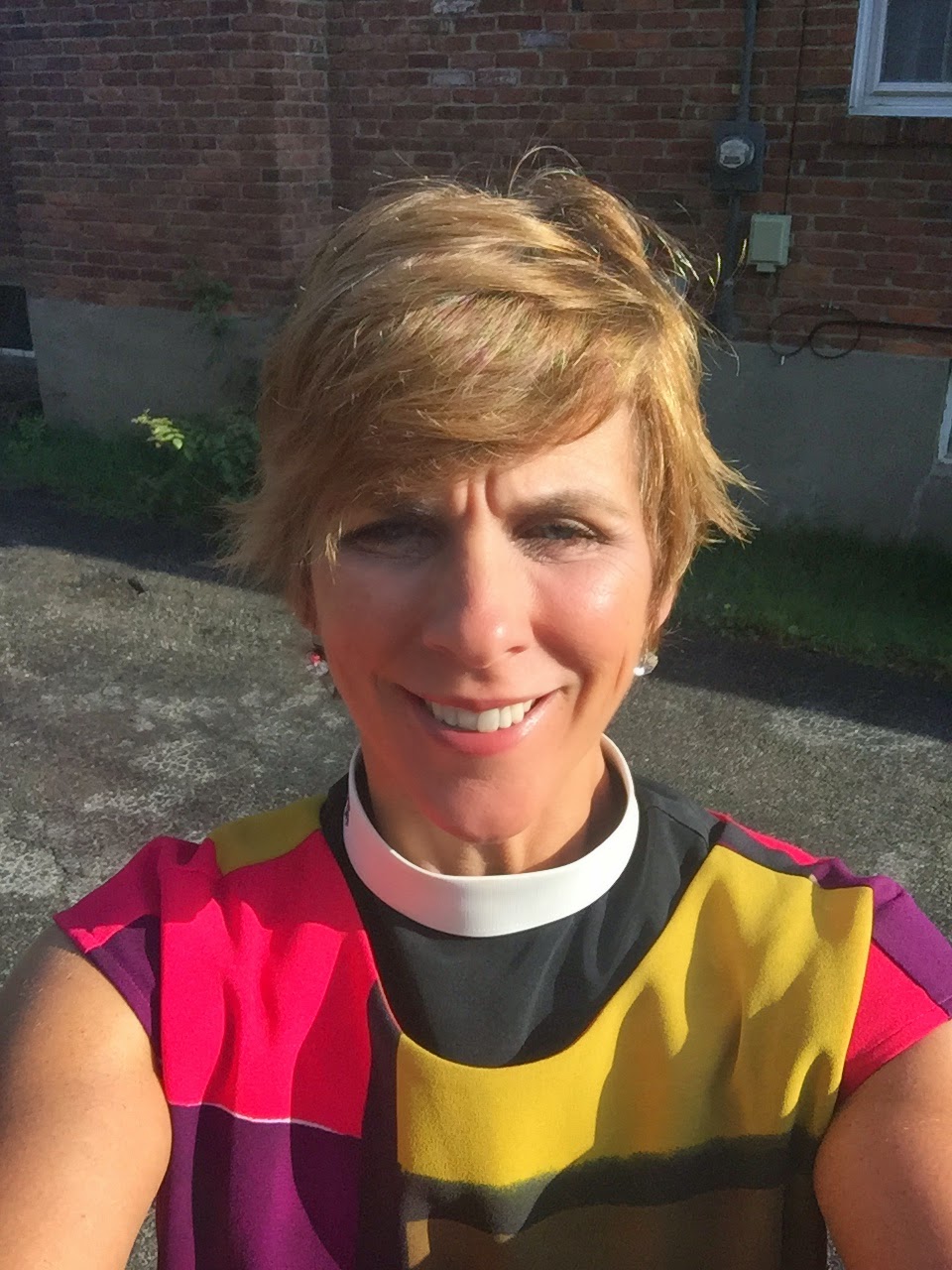
It's not a bug on my collar--it's monogrammed


One of the points the guests on the Diane Rehm show pointed out was  people today don't see the church as the place of authority anymore--they think independently--they don't need to go to the church for all the answers.  They don't want to be TOLD what to believe, how to behave, they want to think. I started thinking how true that is not only in the church but across the spectrum of our lives. Gone are the days when people just accept exactly what a doctor tells them.  Patients bring in their questions, they challenge, they do research--the doctor remains the trained expert, but there is conversation--the patient is not seen as a body to be "fixed" with no input, but rather as a body who knows his/her own body, who has a mind, who has something to contribute. The medical field has had to change or their practices decline--hmmm sounds familiar.  (So most people ask questions, I still don't, but that's because I'm a doctor's daughter and I know I'm going to sign that paper which says the doctor can talk to my Daddy and he'll do the questioning.  One day I'll take over--maybe.)

I think as clergy we have to re-think how we see ourselves--how we view our authority.  We can no longer present ourselves as the paternal, has all the answers, saver of souls, hierarchical expert. Because guess what?  We're not--it's all been a farce anyway and people know it.  We are the trained experts in homiletics, exegesis, Hebrew and Greek (along with many other subjects) and we've had experiences as we've lived out our ministry that is helpful to the conversation, but those who enter our churches (and by the way why do they have to come to us--I think that's a new post to be written), they bring with themselves life experience, expertise in their fields--even and perhaps those most open are our children and youth. If we want people to be open, honest, and vulnerable in our faith communities, don't we have to be too? I believe people want a place where they can bring their questions, their fears, their doubts and we can journey together--and they don't want labels and all or nothing dogma and doctrine.

More and more people are identifying in the political world as independent instead of democrat or republican.  As I was running I was thinking that seems to be indicative of people not wanting a boxed political ideology.  People want to think about individuals issues and not have to "buy into" the whole party line because it's complicated.  I think we have to think about that--if we as the clergy say to belong to this church you have to believe and accept and then give them a list of musts, well, seriously it's no wonder they're leaving.  Let's talk about what we say in the creeds, in the Baptismal covenant, in the Gospels.  Let's hear how people are experiencing these truths in their lives, and perhaps most importantly, let's stop pretending we have all the answers.

Which brings me to Bishop Knudsen (it's coming together, just be a little more patient). she wrote, "the church is losing credibility as a place to bring questions" and that "all of us need to venture into deeper levels of vulnerability and truthfulness."  She wrote in her post on Breaking the Episcopal Glass Ceiling that she feels she is beginning a new ministry that she has been preparing for her entire life.   She has been open about her alcoholism and recovery and both of those have been part of her preparation for this new ministry.  As a person who has been criticized for being too transparent, has been told she shouldn't let people know about parenting mistakes, about any mistakes, who shouldn't be so out there, I give special thanks for Bishop Knudsen and her openness, and I vow to try to have her strength, courage and vulnerability.  Bishop Knudsen brings all of herself into her ministry, I'd like to have the strength, the bravery to do the same--

That's how this post all comes together.  I can't put hats on and off (although I had a gorgeous hat
thanks to Penny--even looked good with jeans and a sweatshirt).  I can't change roles as though they don't overlap, shedding one for the other, because they do.  All of these roles come together as I step into the pulpit and behind the altar on Sunday mornings.  I am a corporate wife who worries I might say something wrong and ruin my husband's career (clearly a dramatic corporate wife) and who also enjoys the people with whom he works.  They are my good friends.  I am also the mother of teens who worries about grades. drinking, and drinking and driving every night but particularly on prom night, because I know it can and does happen, and I am a mother who is grateful she has an open relationship with other parents (even though it may creep Boss out that I text the girlfriend's mother--I really like her--they may break up one day but I've found a friend).  I am a priest that wants to celebrate the new ministry of a colleague, is grateful for shared ministry, who pastors colleagues even long distance and through texts, and who wants to be at every game, banquet, play, and everything else for her children. I am a neurotic person (again that post will come later) who sees a therapist, who has a loving understanding husband, who is the daughter of an alcoholic, and is a person recovering from an eating disorder. All of these things inform my ministry; all of these things are part of my ministry; all of these things are preparation for current and future ministry. All of these things are me..

I believe we can change the religious landscape of America but we have to change first--we have to live into our vulnerability, our fears--we have to stop hiding who we are for fear of losing our authority, and we have to share our questions, doubts, pain and celebration in ministry equally and collaboratively among the priesthood of all believers.  Instead of worrying about which side of the fence the nominals will fall, perhaps we should just tear down the fence.

11 April, 2015

I Am a Modern Day Doubting Thomas

It had been a wonderful Easter weekend; I woke up to a bright sunny Easter Monday; sat down and opened my computer to read the readings for the upcoming Sunday.  I started, as I always do, with the Gospel.  Dear G--why do I have to have routine. Doubting Thomas!  Seriously?!?!?  I may have screamed it aloud, "I DO NOT WANT TO PREACH ON DOUBTING THOMAS!"  I'm not exaggerating when I say my body began to shake.

Why in the world did I agree to preach on Easter 2?  That was the stupidest thing I've ever done.  I have to leave the beach a day early just to preach on Doubting Thomas?  I must have had a momentary complete lapse of judgment when I agreed to that; now how to get out of it?

Dangnabit!  I can't get out of it.  Now I remembered.  The reason I agreed was because it was for my dear friend and colleague.  Why did I have to like him so much?  Why did I want to help him?  Then a lightbulb went on.  I'll use one of the other readings--okay it was a dim lightbulb--who doesn't preach on the Gospel this Sunday?  The lightbulb brightened; I can use my sermon from last year--
same text (John 20:19-31) different church. And if I remembered correctly, it was fairly well received.  Problem solved--now to head out for a run.

I began my run not yet turning on the book I was listening to and heard a voice in my head--the more reasonable voice in my head--"You cannot preach the same sermon.  Different community, different context, different time.  If you preach that same sermon you are in essence (see it was a different voice, who in the world says, 'in essence' to themselves?) saying that nothing has changed since last year.  You have not changed; the world has not changed; there has been no transformation.  If you preach that sermon you are saying that one Easter--one Holy Week--one journey into death and resurrection is all we have, and in essence (stupid words again) the powers of the world have won--will always win."

I began to cry.  I seem to be doing that a lot lately.  I began to cry because I realized that this Lent for the first time in my entire life I did journey into that deep dark place of pain and death--into doubt.  I cried because for the first time  in my life I did question the existence of God.  How in the world could I, a priest--a woman ordained in the Episcopal Church,  proclaim the Gospel when I in fact was Doubting Thomas in the flesh?

People were beginning to stare at me so I turned on my book hoping that would make me forget.  I was listening to Marcus Borg's and John Crossan's book, The Last Week: What the Gospels Really Teach About Jesus' Final Days in Jerusalem. (Harper One; January 2007)  Whatever anyone thinks about these two men as theologians, scholars, liberals or conservatives, I highly recommend this book.  (At least I do now...)

First sentence, seriously very first sentence I heard was, "Growing up the only thing worse than being called a Doubting Thomas was being called Judas."  That did NOT help stop the tears.  But I was crossing the road so I couldn't look down and turn off the book without being hit by a car--the next sentence was something to the effect of, "Just because Thomas doubted doesn't mean he didn't have faith.  But Jesus wanted Thomas to believe and in the Gospel of John believing is about relationship. Jesus wanted to be in relationship with Thomas." And, I thought, Thomas desperately wanted to be in relationship with Jesus.

Perhaps, and possibly worth exploring, I have also been Judas; however, what mattered to me in that moment is that I felt the deep deep pain of Thomas.  I suppose he felt left out and alone.  He hadn't been there with the others--the others believed, had a relationship, and Thomas desperately wanted to believe--to still be in relationship.  I realized that was exactly what happened to me; I was feeling left out and alone--abandoned.  And it struck me hard--what Thomas needed to believe--to be in relationship, to feel relationship--was to touch the wounds of Jesus.  Last year I preached, "Jesus
meets us where we are and in the way we need to be met." I remembered; I had been met where I needed to be met--in and through my wonderful community of teachers and friends--God had not abandoned me; I experienced God through these people. Through them God's existence was again clear--okay not crystal clear but becoming more clear and definitely real and good.  Through my friends I re-believed that God was working to end my pain and was still clearly working in the world to end pain.  My friends and many others are participating with God.

I have to admit, I wasn't entirely convinced I could preach this sermon.  Words of my preaching professors floated in and out of my mind--"do not make the sermon about you.  Make certain your sermon is about proclaiming the Gospel and not a self help talk."  This was going to be a struggle.  I am still hurting; how do I hide that so that I don't make it about me?

I'm not sure....what I did realize on that run was that God was and is transforming the world.  God was and is transforming both personal lives and communities--even when we as individuals, me as an individual don't see it.   As the book says, "Jesus passion was the Kingdom of God and the Kingdom of God is about compassion."  The book continues by saying if we are to follow "the way" we are to enter into personal and political transformation--dying to egoism defined as centering in the anxious and fearful self; its concerns and desires and further compassion and love is central to the life of Jesus and justice is the social form of compassion.

God invites us to participate in the continuing transformation of the world, and I have seen that this year.  I have seen people, communities become passionate about God's passion.  I have seen people and communities come together to love and to strive for justice--people whose only common bond is belief in equality.  As Bishop White says, "God loves everyone no exceptions."  I have seen people living out this truth.


Borg and Crossan write (I'm remembering this and tried to write it down as I was listening so this is not directly quoting) that love is the soul of justice and justice is the flesh--the body of love.  Good Friday is about how powerful the forces of the world are but Easter affirms the Jesus is Lord--the power of the world is not.

I've procrastinated working on this sermon although it's been in floating in the recesses of my mind all week.  I have never been able to totally get away from it.  Yesterday I was touring the College of Charleston with William (a whole other blog--seriously I have a third child getting ready for college?) and as we were standing in front of the library we saw and heard a group of protestors--all
ages, all races, approaching, "Show me what democracy looks like?  This is what democracy looks like." they shouted over and over.  I heard, "Show me what the Kingdom of God looks like?  This is what the Kingdom looks like."  (yes, it's true I teared up).

I know I have to preach on this--from the depths of my soul, from my personal pain and from the hope I have seen in the world.  I have 10 hours in the car today to think about it--I have no idea what the sermon will be but I believe what Borg and Crossan say, "Easter mean's God's great clean up of the world has begun."